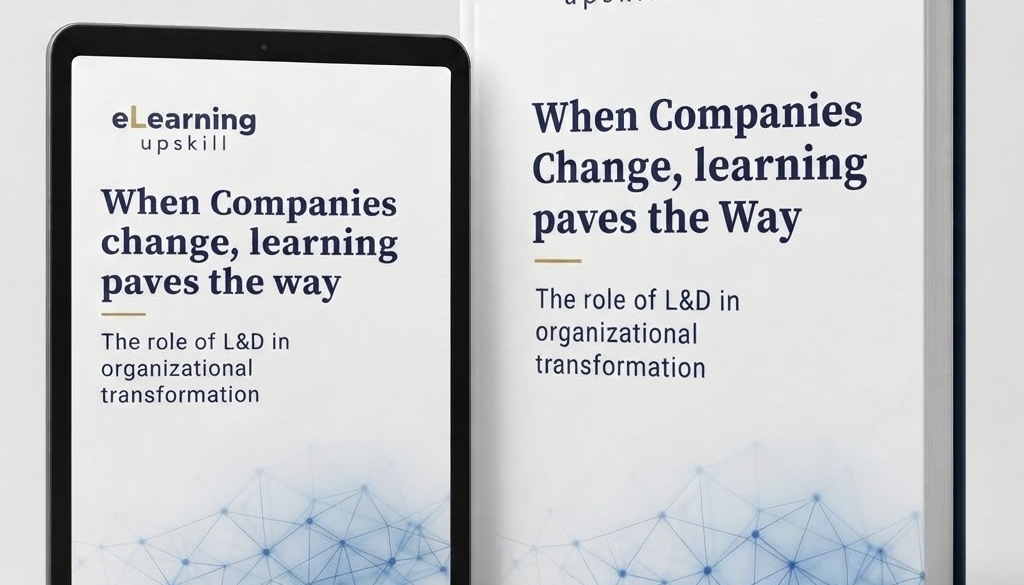
When companies change, learning paves the way: the role of L&D in organizational transformation
Most transformations fail not because of a weak strategy, but because the people who must carry them were never prepared in time. The outcome of any change is decided in the everyday
reality of the teams that have to live it — and that is exactly where learning steps in: done on time, it turns change into opportunity; left too late, even the best decisions begin to lose pace.
In this book we have gathered our experience of supporting the L&D function in the midst of significant change — whether it is run by an internal team or taken on through the full outsourcing of the L&D function. We map the capabilities the new strategy demands, sequence learning in waves that follow the rhythm of each phase, and keep the process steady with clear working standards. These are practices proven in multi-country, multilingual programmes.
No two transformations look alike — each brings its own scale, its own pace and its own challenges. That is exactly why this book treats learning not as a support function of change, but as one of its main engines.
What insights will you learn?
- Why most transformations fail not because of a weak strategy, but because capabilities were built too late — and what that gap looks like in everyday work.
- The capability-first model: why new behaviours must be in place before systems and structures are imposed — and how learning waves follow the phases of change.
- Mergers and acquisitions as a stress test for knowledge: how teams are united and critical expertise is protected during integration — with clear processes and clear ownership.
- Market expansion done properly: full linguistic and cultural localisation, aligned with local regulations and ways of working — not simply translated documents.
- Every type of organisational structure has its own learning architecture — functional, divisional, matrix, project-based, networked, flat or granular — and the rules differ for each.
- Metrics that tell the truth: adoption metrics, completion quality and evidence of changed behaviour — instead of reports designed to flatter.
- What a full-scale eLearning solution looks like: role-based learning paths, a deliberate mix of formats, LMS/LXP configuration, platform governance, standard operating procedures and quality gates that keep the programme stable.
More than a change-management handbook, this book shows what learning looks like when it has become the steady operational foundation of the transformation — the foundation that keeps strategy, people and results in sync.
With the full outsourcing of the L&D function, learning works as one connected ecosystem, not as plain course delivery: the operational framework matters as much as the content itself, and custom eLearning along with a carefully chosen mix of learning formats turn capabilities into reality for every role. The library of courses built along the way becomes an internal knowledge hub — a quiet but valuable asset that keeps delivering value long after the transformation is over.
If your organisation is entering a serious transformation and you want learning to be a structural part of the journey from day one, we would be glad to talk. As a partner for the full outsourcing of the L&D function, we accompany change as a steady expert pillar — we build capabilities before every step and sustain them throughout the entire process.
More practical L&D insights are on the way.